

Ghost in the Shell,
a vision of cyberpunk and dystopian transhumanism
In this work from the last millennium, the cyberpunk genre illustrates humanity's fears of transhumanism through a dystopian and violent universe.
By the ArchEVE team
Archive from 12/27/2634
The film Ghost in the Shell, directed in 1995 by Mamoru Oshii, is often considered one of the foundational works exploring transhumanism in the early 21st century. As an archaeologist in 2630, it is fascinating to see how this cyberpunk vision of modified humanity anticipated questions our machine-integrated society continues to face. Ghost in the Shell provides a dystopian perspective on the implications of integrating technology into the human body, raising ethical questions that still resonate today.

Mamoru Oshii, director of the film, posing in front of posters.
The story of the film unfolds in a future where humans enhanced with cybernetics coexist with conscious androids. Major Motoko Kusanagi, a cyborg with a human appearance, embodies this unsettling fusion of man and machine. While being an enhanced being, she is haunted by existential questions about her identity and soul (the "ghost"). This reflects the anxieties of the era regarding the consequences of transhumanism: the loss of humanity in a society dominated by technology. In doing so, the film anticipated contemporary critiques of excessive reliance on technology while portraying a society where the boundaries between human and android are erased.
The fears raised by Ghost in the Shell echo debates on transhumanist ethics in the 21st century. The film presents a cyberpunk vision where technological advances do not equate to moral or social progress but rather to dehumanization. This dystopian future is marked by a cold, fragmented society where control over individuals is facilitated by technology integrated into their bodies. Conflicts, such as those between Kusanagi and the Puppet Master, an autonomous artificial intelligence, raise fundamental questions about the nature of consciousness, the soul, and individual freedom in the face of pervasive technology.
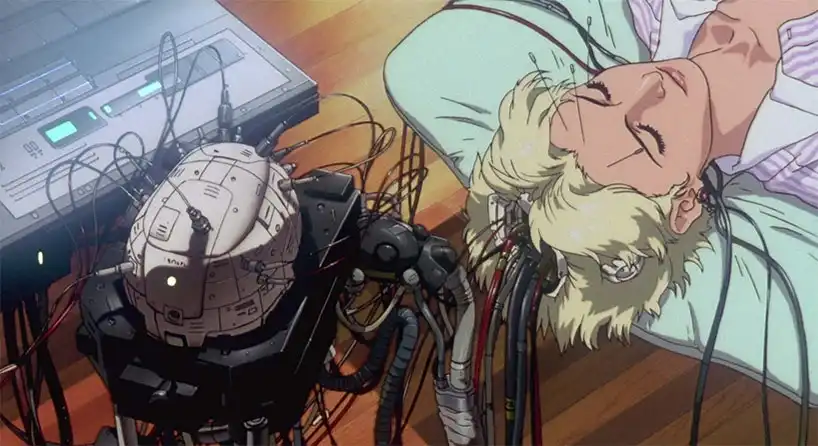
Restored still from the film.
As a witness to an era of transition, Ghost in the Shell represents one of the first cultural reflections on the risks associated with transhumanism. While offering a futuristic and pessimistic vision, the film does not directly condemn human-machine integration. Instead, it serves as a cautionary tale against unregulated technological evolution, foreshadowing the ethical and existential debates our current and future worlds continue to confront.
Ghost in the Shell represents one of the first cultural reflections on the risks associated with transhumanism.
Thus, Ghost in the Shell remains a striking example of the collective imagination of the early 21st century, a work that prefigured the tension between the promise of transcendence and the fear of cybernetic dehumanization.
Film trailer.